Knee pain when squatting is almost never a knee problem. It's a mechanics problem. The knee is the joint taking the load it was handed by the hip above it and the ankle below it. When either of those joints lacks the mobility or strength to do its job, the knee compensates, and compensation under load is what eventually becomes pain.
Most lifters respond to knee pain by reducing depth, adding a wrap, or avoiding squats entirely. Those are workarounds, not solutions. The pain comes back when you push intensity again because the underlying issue never changed.
This guide breaks down the real causes of squatting knee pain, a specific fix for each one, and a clear answer to when knee sleeves are actually the right tool versus when they're a bandage over a problem you haven't addressed.
What You'll Learn
- Why your knees hurt when you squat (it's not the knee)
- 6 causes of squatting knee pain and how to fix each one
- When knee sleeves actually help, and when they don't
Why Your Knees Hurt When You Squat
The squat is a multi-joint movement where ankle mobility, hip strength, and knee tracking all have to work in sequence. A breakdown at any point in that chain gets transferred to the joint that can't escape the load: the knee.
Squatting knee pain usually acts as a map, pointing you to a specific mechanical breakdown. It typically falls into one of three patterns:
- Front (Anterior) Pain: Often a patellofemoral tracking issue (meaning your kneecap isn't gliding cleanly) or excessive forward stress on the joint.
- Inner (Medial) Pain: Usually caused by valgus collapse (the knees caving inward), which is driven by weak hip abductors failing to stabilize your femur.
- Outer (Lateral) Pain: Frequently the result of IT band tension, triggered by tight hips or poor rotational control of the leg.
Each pattern has a different root cause. Treating them the same way is why most lifters stay stuck.
6 Causes of Knee Pain When Squatting (And How to Fix Each One)
1. Knees Caving Inward (Valgus Collapse)
Valgus collapse is the most common squat mechanics error in lifters who experience medial knee pain. The knees drive inward on the descent or ascent, pulling the patella off track and placing extreme strain on the inner ligaments of the knee.
The fix is not to think about your knees. Your knees go where your hips and ankles send them. Valgus collapse is almost always a hip abductor and glute medius weakness issue. The hips fail to stabilize the femur, so the knee falls inward to compensate.[1]
What it looks like: knees track inward off the floor as you drive up, most visibly on heavier sets or when fatigued.
How to fix it:
- Add banded squats to your warm-up: loop a resistance band above your knees and actively push out against it through the full range, 2-3 sets of 15.
- Add direct hip abductor work: clamshells, lateral band walks, or side-lying hip abductions, 3 sets of 15-20 reps, 2x per week.
- Cue "knees out" on every working set and film yourself to verify the pattern is changing.
- Temporarily reduce load until the pattern corrects. Building strength on a collapsing foundation makes the problem worse, not better.
2. Limited Ankle Dorsiflexion
Ankle dorsiflexion is the ability of the ankle to flex, bringing your shin forward over your foot. If your ankles are restricted, your heels rise (placing extreme stress on the front of the knee) or your torso pitches forward excessively to maintain balance (shifting the strain to your lower back).[2]
Limited dorsiflexion is extremely common in lifters who sit for long periods and don't do dedicated mobility work. It's also common in lifters who squat with heels elevated, which masks the restriction rather than fixing it.
What it looks like: heels want to come up when you hit depth, or you have to lean your torso forward significantly to stay balanced at the bottom.
How to fix it:
- Wall ankle stretch: step close to a wall, drive your knee forward over your toes while keeping your heel flat on the floor, 2-3 minutes per side daily.
- Half-kneeling ankle mobility drill: 3 sets of 10-15 reps per side before every squat session.
- Pause squats at the bottom: 3 sets of 3-5 reps with moderate load, pausing 2-3 seconds at the deepest flat-foot position you can hold.
- Do not rely on heel elevation long term. It's useful for loading purposes but doesn't improve the underlying restriction.
Ankle mobility takes 4-8 weeks of consistent work to meaningfully change. Start now.
Related: Lower Back Pain When Squatting: Reasons and How to Fix It
3. Patellofemoral Tracking Problems
Patellofemoral pain is that nagging ache centered right behind or around your kneecap. Think of your kneecap as a train and the groove in your thigh bone as the track. Pain happens when the train doesn't glide smoothly along the track as your knee bends. Under the heavy load of a squat, that minor misalignment causes friction and inflammation.
So, why does it get pulled off track? It usually comes down to a muscular tug-of-war. If your outer quad is significantly stronger than your inner quad (the teardrop muscle just above your knee), it physically pulls the kneecap off-center. Or, just as often, weak glutes cause your thigh bone to rotate inward. When that happens, the kneecap isn't moving off the track. The track is actually moving out from under the train.
What it looks like: aching or grinding sensation at the front of the knee that worsens with high-rep squatting, descending stairs, or sitting with bent knees for extended periods.
How to fix it:
- Add terminal knee extensions to your warm-up: loop a band at shin height, step back to create tension, then fully extend your knee against it, 3 sets of 15-20.
- Spanish squats: loop a heavy band around a fixed point and wrap the other end around the back of your knees/upper calves. Sit back into a squat with vertical shins, letting the band support your weight. 3 sets of 10-15 (or long isometric holds).
- Slow your descent: a controlled 3-4 second eccentric on working sets gives the patella time to track properly rather than being forced through range quickly.
- Reduce session volume temporarily while the tracking pattern improves.
The quad imbalance behind patellofemoral pain responds well to targeted isolation work. It doesn't resolve from squatting more.
4. Stance Width and Toe Angle Mismatch
How far your knees travel is determined by your stance width, femur length, and ankle dorsiflexion. Excessive forward knee travel isn't always a problem. The problem is forward travel without the ankle mobility or posterior chain strength to support it, which shifts weight to the ball of the foot and concentrates load on the anterior knee.[3]
A narrow stance with a toes-forward angle on long femurs is one of the most reliable ways to create anterior knee pain. It's also one of the most fixable.
What it looks like: load feels concentrated at the front of the knee rather than distributed through the full leg. Torso pitches forward as you go deeper.
How to fix it:
- Widen your stance until your torso stays more upright and your knees track comfortably over your toes.
- Turn your toes out 15-30 degrees: this changes the angle of knee travel, effectively shortening the thigh bone from a profile view, and often immediately reduces anterior knee stress. Widen further only if your hips comfortably allow it.
- If you use a narrow stance, prioritize ankle mobility work before increasing load.
- Box squats to a controlled depth: sit back into the hip hinge rather than letting the knees drive forward, 3-4 sets of 5-8 reps.
Stance adjustments often resolve knee pain faster than any other single change. Try it on your next session before concluding you have a structural problem.
5. Weak Posterior Chain
The squat loads the entire lower body, not just the quads. When the hamstrings and glutes are significantly weaker than the quads, the lifter over-relies on the anterior chain to complete the lift. The knee ends up absorbing load that the hip extensors should be handling.
Lifters coming from a running or cycling background often have this problem. Strong quads, underdeveloped hamstrings, and glutes that don't fire efficiently under a barbell.
What it looks like: knee pain that shows up most on the concentric phase, particularly in the mid-range. Squats may also feel like they "fall forward" rather than pressing evenly through the whole foot.
How to fix it:
- Add Romanian deadlifts to your lower body days: 3-4 sets of 8-12 reps at a controlled tempo, 2x per week.
- Hip thrusts: 3 sets of 12-15 reps, focusing on full hip extension and a one-second hold at the top.
- Leg curl variations: lying or seated, 3 sets of 10-15 reps to directly load the hamstrings.
Track your strength ratio over time. A balanced lifter should be able to seated leg curl roughly 60-70% of what they can leg extend for the same reps.
6. Load and Volume Spikes
Tendons and cartilage adapt more slowly than muscle. A program that ramps load or volume faster than connective tissue can handle doesn't produce injury from bad mechanics. It produces injury from exceeding tissue capacity, even with technically correct form.
This is the most common cause of knee pain in lifters who recently started a new program, returned from a layoff, or are running a peaking cycle.
What it looks like: knee discomfort that isn't tied to a specific movement pattern. It often hurts during your first few warm-up sets, feels fine once you are warm, but returns with a dull, stiff ache the next morning. It heavily correlates with a recent increase in sessions, sets, or load.
How to fix it:
- Follow the 10% rule: don't increase total weekly squat volume by more than 10% per week.
- When returning from a break, start at 60-70% of your previous working weights for 2-3 weeks before progressing.
- Use RPE when coming back: working sets should feel like a 7/10 effort, not a 9/10.
- Add a deload week every 4-6 weeks of progressive loading. Connective tissue needs cumulative rest cycles more than muscle does.
Aggressive loading is how you build strength. Managed loading is how you build strength without breaking down in the process.
When Knee Sleeves Actually Help (and When They Don't)
Knee sleeves have two real functions: compression and joint awareness. Neither of them fixes a mechanical problem.
Compression keeps the joint warm through high-volume sessions and can reduce the achiness that accumulates after multiple heavy sets. The sensory feedback from having something fitted tightly around the joint provides added joint awareness, which helps with tracking. Many lifters report better knee control and less valgus drift when wearing sleeves.
What sleeves don't do is correct valgus collapse, improve ankle dorsiflexion, or fix a patellofemoral tracking problem. If your knees hurt because your mechanics are off, wearing sleeves lets you push through pain that your joints are producing for a reason.
| Situation | Use Sleeves? | Why |
|---|---|---|
| Sound mechanics, high volume session | Yes | Compression keeps the joint warm |
| Heavy working sets with good form | Yes | Proprioceptive feedback and support |
| Returning from a resolved issue | Yes | Feedback during return-to-load phase |
| Valgus collapse under load | No | Fix the hip abductor weakness first |
| Anterior knee pain from ankle restriction | No | Address the dorsiflexion restriction |
| Pain from a recent volume spike | No | Reduce load, don't mask the signal |
Use UPPPER Knee Sleeves when:
- Your mechanics are solid and you want joint warmth and joint awareness support on heavy sets
- You're running high volume and your knees accumulate soreness across the session
- You're returning from a resolved issue and want feedback during the return-to-load phase
Don't use knee sleeves to:
- Train through sharp or acute pain
- Compensate for valgus collapse or ankle restriction
- Continue a pattern your joints are already telling you is wrong
The line matters. Sleeves that mask pain can allow a lifter to continue a pattern that's causing real structural damage. Fix the root cause first, then use the sleeves to support good mechanics under load.
Related: Top 5 Exercises That Benefit from Knee Sleeves
Frequently Asked Questions
Should I stop squatting if my knees hurt?
You don't need to stop squatting, but you do need to stop loading the pattern that's producing pain. Reduce load significantly and diagnose the cause before adding intensity back. Squatting through sharp, acute pain is how minor mechanics issues become structural damage. Squatting at reduced load while addressing the root cause is how you fix it without losing months of training.
What's the difference between knee pain during a squat and knee pain after?
Pain during a squat is usually a mechanics issue: valgus collapse, anterior knee stress, or patellofemoral tracking. Pain that shows up hours later or the next morning is more likely a load or volume issue where tissue capacity was exceeded. Both need to be addressed, but they have different causes and different fixes.
Do knee sleeves help with knee pain when squatting?
Knee sleeves reduce discomfort from volume and cold by keeping the joint warm and providing compression, but they don't fix the underlying mechanics causing the pain. If your knees hurt because of valgus collapse or ankle restriction, sleeves let you train through a problem rather than solving it. Address the cause first, then use sleeves to support sound mechanics under load.
Why do my knees hurt at the bottom of the squat but not at the top?
Pain specifically at the bottom of the squat is almost always a mobility restriction issue. Either ankle dorsiflexion is limiting how deep you can go before your body compensates, or hip mobility is forcing your torso to pitch forward and load the knee at end range. Test a wider stance with more toe-out and see if the pain changes before assuming you have a structural problem.
Are squats bad for your knees long term?
Squats performed with sound mechanics are not bad for your knees long term. The research consistently shows that progressive resistance training protects joint health rather than degrading it. The lifters who develop chronic knee issues are usually the ones who trained through mechanics problems for years without addressing them. Fix the pattern, manage the load, and squats are one of the most joint-healthy exercises you can do.
Can I squat with knee pain if I wear knee sleeves?
Only if the pain is mild, volume-related, and your mechanics are confirmed sound. Squatting with compromised mechanics while wearing sleeves is the fastest path to turning a minor problem into a major one. If pain is causing any form change, any depth reduction, or any compensation to avoid discomfort, stop loading the pattern and find the cause.
Fix the Pattern. Then Load It.
Knee pain when squatting is information. Your body is telling you something in the chain isn't holding up under the load you're asking it to handle.
The fix is almost never rest and try again. It's identify the pattern, address the specific cause, and rebuild the movement with mechanics that stop transferring stress to the knee. Lifters who do that work come back squatting heavier than before because they fixed a structural weakness they didn't know they had.
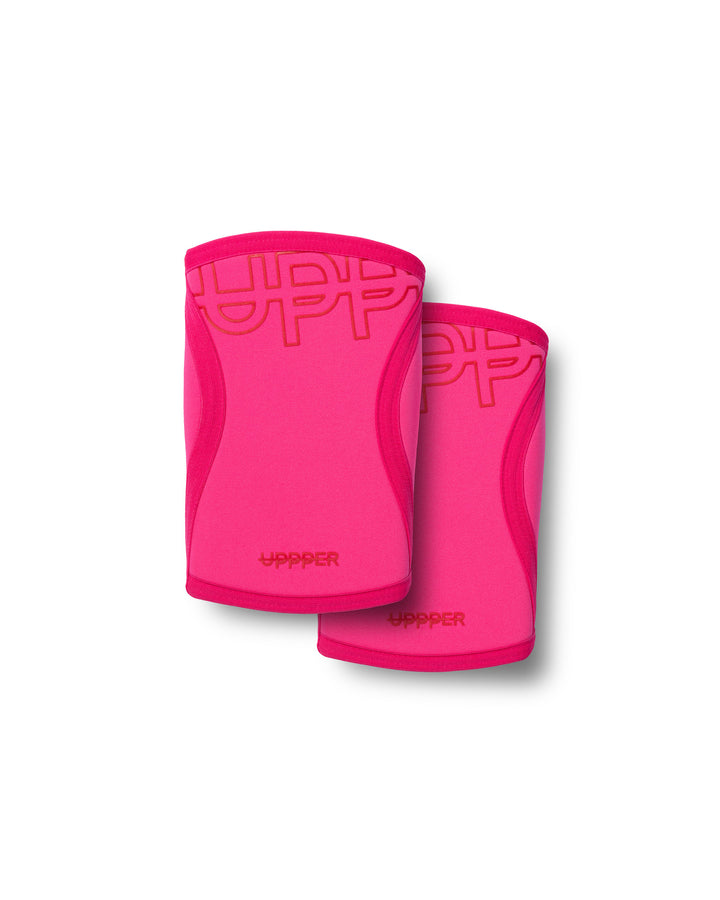
When your mechanics are sound and your load is managed, your knees should be able to handle the work. On your heaviest sets, UPPPER Knee Sleeves keep the joint warm, support tracking, and give you the joint awareness feedback you need to stay in a clean pattern through every rep. Shop UPPPER Knee Sleeves
References
- Powers, C. M. (2010). The Influence of Abnormal Hip Mechanics on Knee Injury: A Biomechanical Perspective. Journal of Orthopaedic & Sports Physical Therapy (JOSPT), 40(2), 42-51. https://www.jospt.org/doi/10.2519/jospt.2010.3337
- Macrum, E., et al. (2012). Effect of Limiting Ankle-Dorsiflexion Range of Motion on Lower Extremity Kinematics and Muscle-Activation Patterns During a Squat. Journal of Sport Rehabilitation, 21(2), 144-150. https://pubmed.ncbi.nlm.nih.gov/22100617/
- Schoenfeld, B. J. (2010). Squatting Kinematics and Kinetics and Their Application to Exercise Performance. Journal of Strength and Conditioning Research, 24(12), 3497-3506. https://journals.lww.com/nsca-jscr/fulltext/2010/12000/squatting_kinematics_and_kinetics_and_their.40.aspx