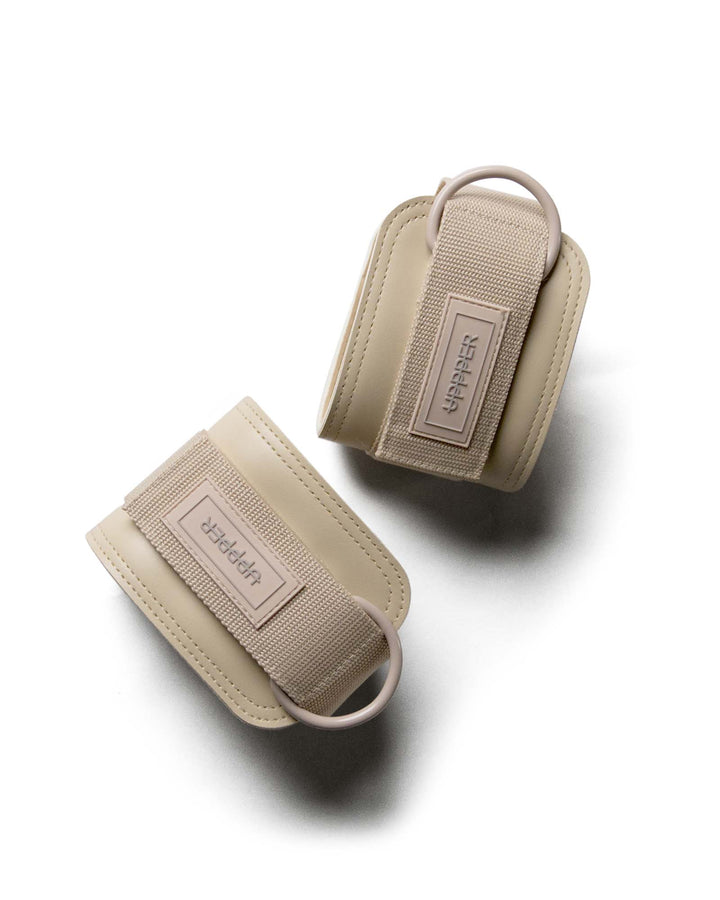
Cable ankle straps turn the stack into a single-joint hip isolation machine. Clip one on, and every kickback, abduction, and leg curl loads the glutes and hips under constant tension. That's something a barbell squat or deadlift physically can't do, because those lifts move the hip through a shared range with the knees and back.
Here's the part most lifters miss: your compounds aren't failing you. They're just not built to isolate. A squat loads the glute through the mid-range of hip extension. It only asks the glute medius to stabilize statically rather than move through a loaded range of motion, and it never trains one side without the other quietly picking up the slack.
That gap is why lifters with strong squat numbers still have flat, underdeveloped glutes and hips that feel unstable on single-leg work. Ankle straps close it directly.
This guide breaks down 4 cable ankle strap exercises: the exact setup, tempo, and rep ranges, built to isolate what your compound lifts leave on the table.
What You'll Learn
- Why your glutes stay flat even when your squat numbers go up
- 4 cable ankle strap exercises with exact setup, tempo, and rep ranges
- When to do ankle strap work relative to your main lifts
Why Your Glutes Stay Flat Even When Your Squat Numbers Go Up
Some lifters assume glute development is just a byproduct of squatting and deadlifting heavier. It isn't. Here's what's actually missing:
- No end-range hip extension. Squats and deadlifts load the glute through the middle of the range, not the fully extended, fully squeezed position where kickbacks and hip extensions live.[1]
- Zero lateral loading. Nothing in a standard leg day trains the hip to resist or produce force sideways. That's the gluteus medius and minimus, and they stay under-stimulated without direct abduction work.
- Unchecked side-to-side imbalance. Bilateral lifts let your dominant leg compensate for the weaker one. You never find out which side is behind until you load them one at a time.
Heavy squats build massive legs, but they don't guarantee a fully developed bottom. You can't just squat your way out of flat glutes. They need to move in the directions your barbell ignores.
The 4 Cable Ankle Strap Exercises
1. Cable Kickbacks: Load the Glute Max Through Full Hip Extension
Cable kickbacks isolate the gluteus maximus by loading hip extension against constant resistance, from a stretched position at the ankle all the way to a full lockout squeeze. It's the heaviest, most foundational glute isolation movement the cable stack offers.
When this breaks, it looks like a hip hinge with extra steps: the lower back arches, the working leg swings from momentum, and the glute never actually reaches lockout.
- Attach the ankle strap to a low pulley and face the machine.
- Hinge forward slightly, hands on the frame for stability.
- Drive the working leg straight back and up, pausing 1 second at full extension.
- Control the return for a full 2 seconds, no bouncing off the bottom.
- 3 sets x 12-15 reps per leg.
If your lower back is moving more than your hip, that's not a kickback. That's a deadlift with worse mechanics.
2. Cable Hip Abduction: Build the Glute Medius Your Squat Skips
Hip abduction moves the leg away from the body's midline, directly targeting the gluteus medius, the muscle responsible for hip and knee stability on every single-leg movement you perform, from lunges to sprinting.[2]
When this breaks, the torso leans away from the working leg to fake extra range. That's momentum borrowing from your obliques, not the medius doing its job.
- Attach the strap to a low pulley, stand sideways with the working leg farthest from the machine.
- Keep the standing leg soft, torso stacked directly over the hips.
- Lift the working leg out to roughly 45 degrees, pause, then control it back.
- 3 sets x 15-20 reps per side, 2-1-2 tempo.
3. Cable Hip Adduction: The Missing Half of Hip Stability
You can't train abduction without training adduction. Working the inner thigh balances the hip joint and builds the structural stability required to handle heavy, unilateral loads without your pelvis shifting out of alignment.
When this breaks, your hips lack lateral balance, creating a weak foundation for heavy squats and dynamic athletic movements.
- Attach the strap to a low pulley, stand sideways with the working leg closest to the machine.
- Brace through the core - this is a single-leg stability move as much as a strength move.
- Pull the working leg across the body's midline, pause, then return under control.
- 3 sets x 15 reps per side.
Standing on one leg while pulling a loaded cable across your body will expose a weak brace fast. Mastering the science of bracing and intra-abdominal pressure is exactly how you build the core stiffness needed to stay stable here.
4. Standing Cable Leg Curl: Direct Hamstring Work Your Deadlift Doesn't Finish
The standing cable leg curl isolates the hamstring's knee-flexion function: the part of the muscle a hip-hinge pattern like a deadlift or RDL never directly trains, since those lifts load the hamstring through hip extension, not knee flexion.[3]
When this breaks, the knee drops forward and the thigh swings with every rep, using momentum from the hips to cheat the weight up instead of forcing the hamstring to do the work.
- Attach the strap to a low pulley and face the machine, stepping back slightly so the cable is taut.
- Hinge forward slightly at the hips, holding the frame for balance.
- Keep your working thigh locked in place - only the lower leg should move.
- Curl the heel toward the glute, pause at peak contraction.
- Lower for a full 2-count, control the eccentric.
- 3 sets x 12-15 reps per leg.
That's the core four. Run them consistently for a full training block before adding anything else.
Frequently Asked Questions
What muscles do cable ankle straps actually work?
Depending on the exercise you perform, ankle straps can isolate almost any muscle crossing the hip and knee joints. They are primarily used to target the gluteus maximus, gluteus medius, hip adductors, and hamstrings, but can also be used for anterior work like the hip flexors. Because the resistance attaches at the ankle, the load stays on the working leg for the entire range of motion, which is what makes single-joint isolation possible.
Do I need resistance bands or cable ankle straps for glutes?
You don't have to choose. They do different jobs. Cable ankle straps deliver constant resistance that scales with the weight stack, which is what makes them the better tool for progressive overload and long-term strength. Resistance bands increase tension as they stretch, pack into a gym bag, and work best as an activation tool, looped around the knees for hip thrusts, bridges, or lateral walks before you train. Use bands to activate, cables to load the actual working sets. They're not interchangeable. Skipping the cable work in favor of bands alone caps how much resistance you can progressively add over time.
Should I do ankle strap work before or after my squats and deadlifts?
Cable ankle strap exercises belong after your main compound lifts, not before. Doing isolation work first pre-fatigues the glutes and hamstrings, which can reduce the load you're able to move safely on a heavy squat or deadlift.
Are cable ankle straps enough to grow my glutes on their own?
Cable ankle straps supplement your compound lifts; they don't replace them. Squats and deadlifts build overall raw strength, while ankle strap work targets the specific angles and ranges of motion those heavy lifts leave out. Cutting either one leaves a gap the other can't cover.
How many days a week should I train with cable ankle straps?
Two to three sessions per week is enough to build meaningful glute and hip strength without interfering with recovery from your main lifts. Pair one or two ankle strap exercises with each lower body day rather than running all four in a single session.
You're Not Undertrained. You're Under-Isolated.
Your glutes and hips aren't the weak point in your program. They're just the muscle group that's been doing everyone else's job: stabilizing, assisting, compensating, without ever getting trained directly.
That's what changes when you stop treating the cable stack as a finishing-move machine and start using it the way it's built to be used: one joint, one direction, one leg at a time.
You don't need a heavier squat this week. You need a hip that fires the same way on both sides, and gear that actually stays locked in place while you build it. Shop UPPPER Ankle Straps
References
- Contreras, B., et al. (2015). A comparison of gluteus maximus, biceps femoris, and vastus lateralis electromyographic activity in the back squat and barbell hip thrust exercises. Journal of Applied Biomechanics, 31(6), 452-458. https://pubmed.ncbi.nlm.nih.gov/26214739/
- Macadam, P., Cronin, J., & Contreras, B. (2015). An examination of the gluteal muscle activity associated with dynamic hip abduction and hip external rotation exercise: a systematic review. International Journal of Sports Physical Therapy, 10(5), 573-591. https://pmc.ncbi.nlm.nih.gov/articles/PMC4595911/
- Schoenfeld, B. J., et al. (2015). Regional differences in muscle activation during hamstrings exercise. Journal of Strength and Conditioning Research, 29(1), 159-164. https://pubmed.ncbi.nlm.nih.gov/24978835/